Why Local Business Advertising Will Change the Way You Use QR Codes and Google Maps
The days of local marketing being a "guess and check" game are over. For decades, you’d put up a poster, hand out a flyer, or run a small ad and hope the phone rang or someone walked through your door. You knew it worked: because your regulars told you so: but you couldn't see the exact path they took from seeing your sign to standing at your counter.
But the reality is, the way people navigate the physical world has fundamentally changed. Today, your potential customers are constantly toggling between what they see on the street and what they see on their screens. If you aren't bridging that gap, you're leaving foot traffic on the table.
By combining traditional poster and flyer distribution with modern tools like QR codes and Google Maps, you aren't just advertising; you're building a high-conversion funnel right on the sidewalks of the Bay Area.
Google Maps is Your New Digital Front Door
Think about the last time you looked for a new coffee shop or a hardware store. Did you search for a website, or did you open Google Maps? For most people, Google Maps is the first and last stop in the local buying journey.
When someone sees your poster in a high-traffic area like the Mission District or Downtown Oakland, their first instinct isn't to memorize your URL. It’s to see how far away you are. Google Maps has become the primary interface for local intent. It provides the "Local 3-Pack": those top three results that appear on a map: which is where the vast majority of foot traffic is won or lost.
Ideally, your local advertising should serve as a shortcut to that map listing. By making it easy for a passerby to pull up your location, you’re removing the friction that usually kills a local lead. You aren’t just telling them you exist; you’re giving them the turn-by-turn directions to get to you.
The QR Code Renaissance: More Than Just a Link
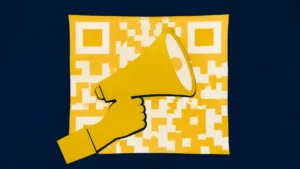
Remember when QR codes were considered a gimmick? Those days are gone. Since 2020, every smartphone user in the Bay Area knows exactly how to scan a code in seconds. In the context of local business advertising, a QR code is no longer just a link to a website; it is the "connective tissue" between your physical presence and your digital tracking.
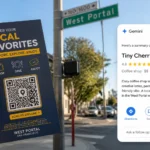
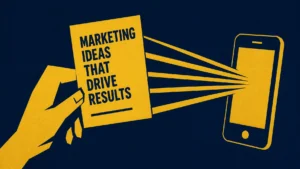
When you place a QR code on a well-designed poster, you are essentially turning a piece of paper into a clickable ad. But the secret is where you send them. Don't just send them to your homepage. Instead, link that QR code directly to your Google Maps listing or a "Get Directions" page.
Why does this matter? Because the moment they scan that code, you've moved them from a passive observer to an active lead. You can even use unique QR codes for different neighborhoods. Imagine knowing that your posters in Berkeley are driving twice as many map lookups as your posters in San Mateo. That is the kind of data that local businesses have dreamed of for years.
Creating the High-Traffic Loop
The most effective local marketing doesn't happen in a vacuum. It happens in a loop. Here is how you should be thinking about your campaign structure:
The Hook: A bold, high-contrast poster or flyer placed in a strategic, high-foot-traffic location. (Check out our poster hanging tips for the best spots).
The Bridge: A prominent QR code with a clear call to action, like "Scan for Directions" or "Get Today's Special."
The Destination: Your Google Business Profile. This is where they see your 5-star reviews, your photos, and that beautiful blue "Directions" button.
The Result: The customer follows the blue line on their screen right into your store.
This loop works because it meets the customer where they are. They are already on the street, and they are already holding their phone. You are simply providing the easiest path for them to follow.
Tracking Your Real-World ROI
One of the biggest pitfalls for small businesses is spending money on advertising without knowing if it’s actually working. "I know half my advertising budget is wasted," the old saying goes, "I just don't know which half."
By using localized QR codes and Google Maps tracking, you can finally solve this puzzle.
What you should be measuring:
Scan Volume by Location: Which neighborhoods or specific bulletin boards are generating the most interest?
Map "Direction" Requests: How many people who scanned the code actually asked for directions?
Conversion Rate: If you offer a specific "QR-only" discount, how many of those were redeemed at the register?
The next thing you’ll need to do is look at your distribution strategy. If you see that your posters in the Richmond District are outperforming your flyers in the Haight, you can shift your budget to where the real results are. This makes your marketing "simpler than META and cheaper," as our clients like to say.
Why Placement is Everything
You can have the best QR code and the most optimized Google Maps listing in the world, but if your posters are hidden in a back alley, they won't do you any good. Local business advertising is a game of visibility.
Since 1976, Thumbtack Bugle has been navigating the unique landscape of the San Francisco Bay Area. We know which window displays in the Castro get the most eyeballs and which community boards in Oakland are checked daily by locals.
Ideally, your physical ads should be placed where people are already "pausing." Think of transit stops, coffee shop windows, and community hubs. These are places where people have the five seconds of downtime required to notice a poster, pull out their phone, and scan a code.
The Science of the "Scan-to-Visit" Strategy
Is your current marketing strategy feeling a bit disjointed? Are you running digital ads that feel disconnected from your local community? Or maybe you're doing physical distribution but feel like you're flying blind?
The "Science" of local advertising today is integration. When you combine the physical authority of a hand-placed poster with the digital utility of Google Maps, you create a presence that is hard to ignore. It makes your business feel like a permanent part of the neighborhood fabric, rather than just another targeted ad in a social media feed.
Start Driving Real Foot Traffic Today
If you’re ready to stop guessing and start growing, it’s time to rethink how you reach your local audience. The Bay Area is a busy place, but with the right bridge between your physical and digital marketing, you can guide customers straight to your door.
Whether you need a full-scale Bay Area-wide distribution or a targeted campaign in a single neighborhood, we have the experience and the local knowledge to make it happen. We've been doing this for 50 years: let us show you why physical marketing is more relevant now than ever.
Contact Thumbtack Bugle to plan your next campaign:
Phone: 415-685-9477
Address: 3871 Piedmont Avenue #323, Oakland, CA 94611