How to Avoid the Biggest Poster Distribution Pitfalls During the SF Summer Rush
San Francisco in the summer is a different beast. Between the massive crowds at Pride, the music lovers flooding Golden Gate Park for Outside Lands, and the constant stream of neighborhood street fairs, the city is buzzing with energy. For a local business or event organizer, this looks like a goldmine of opportunity. You see the foot traffic and think, "I just need to get my flyer in front of those people."
But here is the reality: summer in the city is also the most competitive time for your physical marketing. If you don't have a solid plan, your expensive posters will end up as litter, your street team will be ignored, and you might even find yourself facing a hefty fine from the city.
At Thumbtack Bugle, we’ve been navigating these streets since 1976. We’ve seen every mistake in the book. If you want your campaign to actually drive results: like the clients who tell us they got "8 new students from one campaign": you need to avoid these five common pitfalls.
1. The "Public Property" Trap: Don't Get Slapped with a Fine
It is tempting to see a clean utility pole or a traffic signal box and think it’s the perfect spot for your 11×17 poster. Why not? Everyone else seems to be doing it.
But the reality is that San Francisco Public Works has strict "Post No Bills" laws. Taping, stapling, or gluing posters to public property: including streetlights, public fences, and bus shelters: is illegal. Not only does the city move quickly to tear these down, but they also track back the information on the flyer to issue citations and cleanup costs to the business involved.
Ideally, you want your marketing to build goodwill, not leave a mess. Instead of the "guerilla" approach that risks a legal headache, focus on:
Private Community Boards: Cafes, laundromats, and gyms often have designated spaces for local flyers.
Storefront Windows: With the owner's permission, a window placement offers high visibility without the risk of city fines.
Permitted Street Teams: Hand-to-hand distribution on public sidewalks is perfectly legal, provided you aren't obstructing traffic.
The next thing you’ll need to do is ensure your team knows exactly where the "safe zones" are. Or, you can partner with an agency like ours that already knows the Bay Area wide distribution routes that are both effective and compliant.
2. Ignoring the "June Gloom": The Science of Material Choice
Newcomers to San Francisco often make one critical mistake: they assume summer means "sunny and dry." If you’ve spent a morning in the Sunset or Richmond districts, you know that the "June Gloom" and July fog are very real.
The moisture in the air can turn a standard paper flyer into a soggy, curled-up mess in less than two hours. Have you ever walked past a community board where all the flyers are limp and unreadable? That is a wasted marketing budget.
To survive the SF summer weather, you need to think about durability:
Weight Matters: Use a heavier cardstock (at least 80lb or 100lb) rather than standard printer paper. It stays flat even when damp.
Glossy vs. Matte: A slight UV coating or a glossy finish acts as a water-resistant barrier against the morning mist.
Ink Quality: Ensure your printer uses high-quality inks that won't bleed when they get a little damp.
When we plan a campaign for our clients, we don't just look at the design; we look at the environment. A flyer that looks great on your screen is useless if it can't stand up to a San Francisco morning.
3. The "White Noise" Problem: How to Stand Out on a Crowded Board
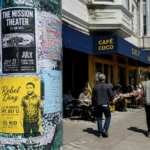
During the summer rush, every community board in the city looks like a chaotic collage. From North Beach to the Mission, posters are layered on top of each other. If you just pin your flyer to the board without a strategy, it will be buried within 24 hours.
This is where the science of placement comes in. Most people scan a bulletin board like they scan a webpage: starting at the top left. But more importantly, the human eye is drawn to high contrast and bold typography.
Common pitfalls in design include:
Too much text: People are walking by; they won't stop to read a paragraph. Use one bold headline.
Small fonts: If I can't read your event date from six feet away, I'm not going to bother moving closer.
Cluttered visuals: Pick one strong image or a bright background color (like our signature vibrant yellow) to break through the visual noise.
Take a look at how professional placements are handled on our sample work page. Notice how the most effective posters use a clear hierarchy of information. If you're struggling with this, our team offers copywriting and design services to ensure your materials actually get read.
4. Timing Errors: Missing the Event Window
The "Summer Rush" isn't just one long season; it's a series of high-intensity spikes. If you are promoting an event for the weekend of Outside Lands, but you wait until the Monday before to start your distribution, you’ve already lost.
The most sought-after spots in cafes and bars fill up weeks in advance. Furthermore, your target audience needs multiple "touchpoints" before they take action.
Ideally, your distribution schedule should look like this:
Wave 1 (4 weeks out): Establishing awareness in key neighborhoods.
Wave 2 (2 weeks out): Saturating high-traffic areas near the event location.
Wave 3 (Event week): Last-minute street team handouts at transit hubs like BART stations or busy bus stops.
Are you timing your distribution to coincide with when your customers are actually out and about? If you’re promoting a tech startup, hitting the Caltrain station during the morning rush is better than a random Tuesday afternoon in a quiet park.
5. Geographic Tunnel Vision: Don't Forget the Rest of the Bay
Many businesses get so focused on San Francisco proper that they forget about the thousands of people commuting from Oakland, Berkeley, and the Peninsula. If you’re hosting an event in the city, your audience is likely coming from across the bridge.
The pitfall here is assuming that an "SF Campaign" only happens in SF. A truly effective summer campaign should follow the flow of the people. This means:
Oakland & Berkeley: These areas have some of the most active community boards and pedestrian-heavy streets (like Piedmont Avenue or Telegraph Avenue).
The Peninsula: Towns like San Mateo and Palo Alto are prime territory for service providers and family-oriented events.
The North Bay: San Rafael and Marin offer a different, often higher-income demographic that is frequently overlooked by "city-only" agencies.
We cover all these areas because we know that local marketing doesn't stop at the city limits. You can find a full list of our coverage areas and distribution rates here.
The Bottom Line: Work with the Experts
Physical marketing in the Bay Area is incredibly effective, but it isn't "set it and forget it." It requires local knowledge, respect for the rules, and a deep understanding of the city's unique rhythm.
Why spend your summer worrying about whether your posters are still up or if you're about to get a call from the city? Let us handle the heavy lifting. We’ve been the "original lifestyle marketing agency" for San Francisco for 50 years, and we know exactly how to make your brand stand out in the summer crowd.
Ready to start your summer campaign?
Contact Thumbtack Bugle today. We'll help you plan, design, and distribute a campaign that actually moves the needle for your business.